

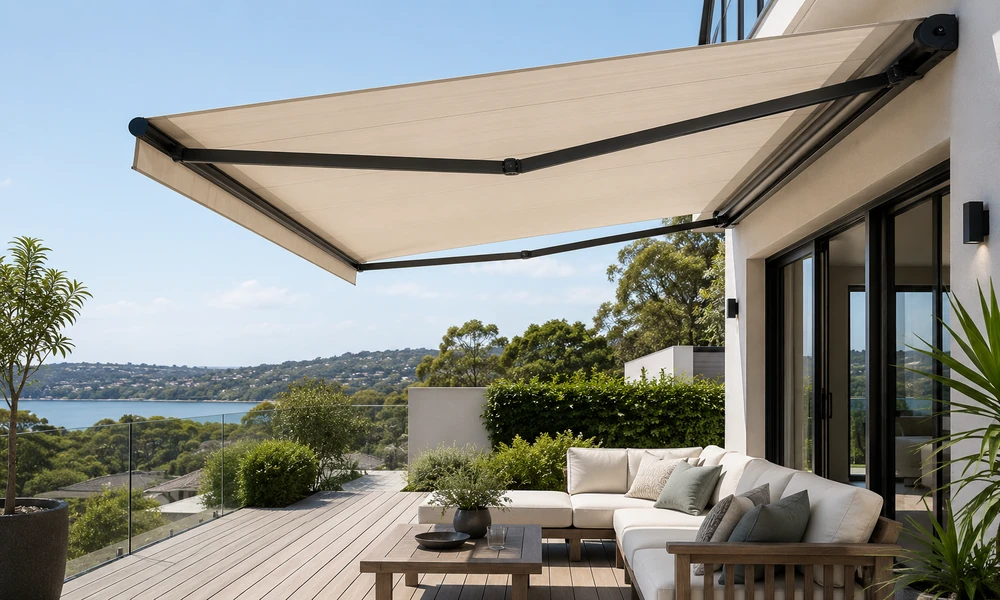
A good outdoor area is only usable if it has shade. In much of Australia, summer UV levels regularly reach the extreme range, and a deck that gets full afternoon sun can sit empty from November to March. That’s why folding arm awnings have become one of the most popular upgrades for patios, balconies and alfresco areas.
Unlike a fixed pergola roof, a folding arm awning extends when you need shade and folds away when you want the sun back. Sydney installers such as Roma Blinds fit them on everything from Eastern Suburbs apartments to Northern Beaches homes. Below are the questions worth answering before you get a quote.
How big can they go?
Folding arm awnings are measured two ways: width across the wall, and projection, which is how far the awning reaches out from the wall.
- Larger residential systems from some brands go up to around 7 metres wide and 4 metres in projection.
- A small apartment balcony may only need around 2 metres of projection.
- For a typical deck or patio, 3 to 3.5 metres of projection gives useful shade through most of the afternoon.
A good rule: measure the area you actually sit in, then allow extra projection on west-facing spaces, where the late sun comes in at a low angle.
How much wind can they handle?
This is the most important question, and the one people skip. Folding arm awnings are designed for shade, not storms. Many are rated to handle winds up to around level 5 on the Beaufort scale, roughly 29 to 38 km/h, and should be retracted when winds pick up beyond that.
If the awning is over an exposed balcony or a coastal deck, consider a motorised system with a wind sensor. It retracts the awning automatically when gusts get too strong, which protects both the frame and the fabric when you’re not home.
Open arm or full cassette?
| Type | How it looks retracted | Best for |
|---|---|---|
| Open arm | Fabric roll and arms visible | Sheltered areas under eaves, lower budgets |
| Semi cassette | Fabric covered on top | Partly exposed walls |
| Full cassette | Fabric and arms fully enclosed | Exposed, coastal or high-rise walls |
A full cassette costs more, but it keeps dust, salt and rain off the fabric, which helps it last longer.
Manual or motorised?
Manual awnings use a crank handle and cost less. Motorised awnings run from a remote or wall switch and can link to sun and wind sensors. For wide awnings, or ones you’ll use daily, motorisation is the option most homeowners end up glad they chose.
Fabric and colour
Look for solution-dyed acrylic or architectural awning fabrics. They hold their colour in strong sun and dry quickly after rain. Lighter colours keep the area underneath brighter, while darker shades give deeper shade and hide marks better.
What does it cost?
Pricing varies widely with width, projection, cassette type and whether the system is motorised. Get at least two quotes on the same size and specification so you’re comparing like with like, and check what warranty applies to the frame, motor and fabric separately.
Apartments and strata
In an apartment, an awning usually counts as a change to the building’s exterior. Check with your strata committee before ordering, as many buildings set rules on colour, style and fixing.
The bottom line
A folding arm awning can turn a hot, unused deck into an outdoor room. Size it to where you actually sit, respect its wind limits, choose a cassette for exposed walls, and think about motorisation with a wind sensor. Get those right and it will give you shade for many summers.
