

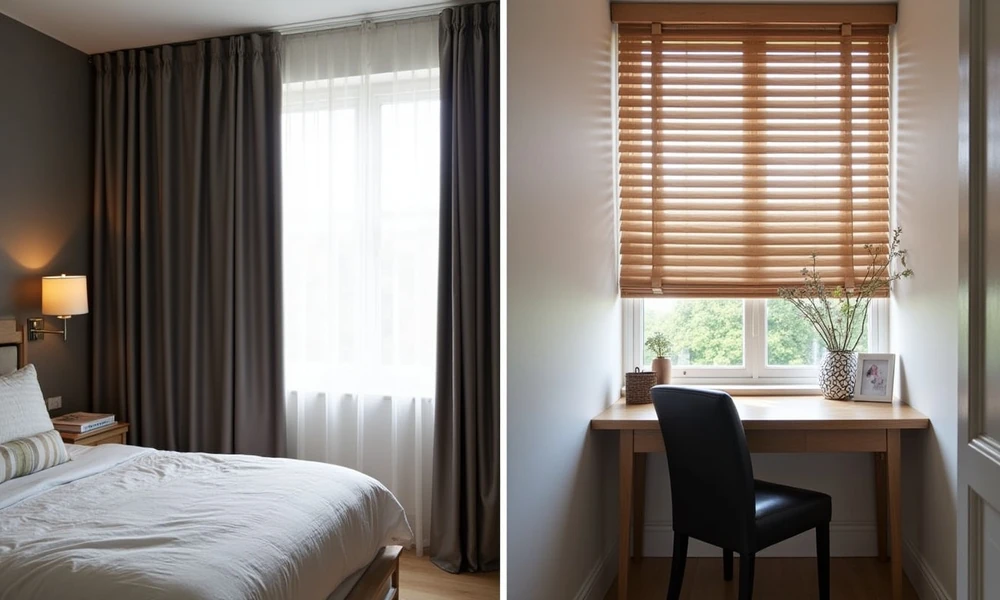
Image Recommendation: A split view of a bedroom with fully drawn blackout curtains beside a home office with venetian blinds tilted at an angle.
A homeowner redoing their living room usually treats the choice between curtains and blinds as a style decision, fabric versus slats, soft versus structured, and leaves it there. Once motorisation enters the picture, that same choice quietly becomes a functional one too, because a smart curtain and a motorised blind aren’t solving the same problem, just wearing different outfits. They’re built around different mechanisms, and those mechanisms end up mattering more than which one looks better in a photo.
What a Curtain Motor Is Actually Moving
A motorised curtain system works by pulling fabric along a track using a small motor fitted into or alongside the track itself, essentially automating the same traverse-rod motion someone would otherwise do by hand. Because the fabric itself is doing the work of blocking light, a properly fitted smart curtain in Singapore setup tends to offer fuller coverage along the edges of a window, including the overlap against the wall that cuts down on light leaking in from the sides, something a track-mounted blind generally can’t replicate no matter how well it’s installed. That same fabric also adds a layer of sound dampening a hard blind doesn’t, since soft, heavy material absorbs more ambient noise than flat slats or a rolled sheet.
What a Blind Motor Is Actually Doing Differently
A motorised blind, whether roller, venetian, or roman, works through an entirely different mechanism: raising, lowering, or tilting a single continuous surface rather than drawing fabric sideways along a track. That difference is what gives blinds their main advantage: precise, incremental light control. A venetian blind can be tilted to let light in at an angle while still blocking a direct line of sight, something a curtain simply can’t do halfway; a curtain is either open, closed, or somewhere in between in a much blunter sense. For a room where exact glare control throughout the day matters more than blocking every sliver of light, that precision tends to matter more than coverage.
Which Rooms Tend to Lean Which Way
- Bedrooms needing full blackout: curtains, especially with a blackout lining, generally outperform blinds on total light coverage.
- Home offices with a lot of screen glare through the day: blinds, particularly venetian or honeycomb styles, give finer control over angle without losing the view entirely.
- Living rooms facing a busy street: curtains add a meaningful amount of sound dampening that blinds don’t.
- Bathrooms and kitchens: blinds are usually easier to keep clean and more resistant to humidity than fabric.
Retrofitting an Existing Setup Isn’t Always Equal Either
Adding motorisation to an existing curtain setup is often simpler than people expect, since many tracks can be fitted with a motor without replacing the curtain fabric itself. Switching to motorised blinds in Singapore more often means replacing the entire unit rather than retrofitting an existing manual one, since the motor and the blind mechanism are usually built together rather than added on afterwards. That difference in installation effort is worth knowing upfront, since it changes both the cost and the disruption involved in a renovation meant to upgrade one room at a time rather than the whole home at once.
What Actually Decides the Right Choice for a Specific Room
The right choice usually comes down to which problem matters more in a specific room: total light and sound coverage, or fine, repeatable control over exactly how much light gets in. A north-facing bedroom with a quiet outlook might not need either feature particularly badly, while a west-facing home office catching harsh afternoon sun almost certainly does, just not necessarily the same fix a bedroom down the hall needs. Treating every room in a home the same way is usually where this decision goes wrong.
None of this makes one option objectively better than the other, since they’re built to solve genuinely different problems rather than compete on the same one. The question worth asking isn’t which is the smarter upgrade in general; it’s which problem is actually showing up in that specific room, and how it behaves at different times of day, since a room that feels fine at 10am can feel completely different by 4pm once the sun has shifted.
Working out which mechanism actually fits a specific room is easier with an actual look at the space than a general comparison on a page. Contact De Art Studio to have that conversation.
